
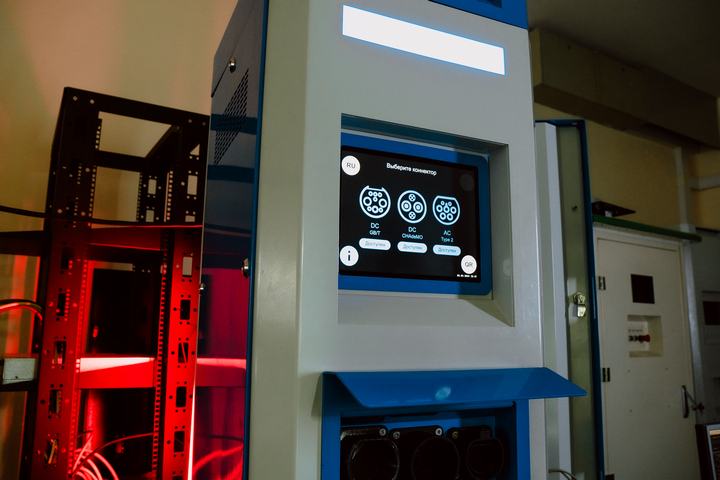
Engineers of the Novosibirsk State Technical University, together with the Krasnoyarsk scientific and production enterprise Radiosvyaz, have released the first batch of electric charging stations capable of operating at extremely low temperatures. The development was carried out within the framework of the Priority 2030 program.
According to the project manager, Head of the Department of Electrotechnical Complexes at NSTU-NETI, Doctor of Technical Sciences, Professor Nikolai Shchurov, the joint project of the university and NPP Radiosvyaz is aimed at developing key components and the stations themselves within the framework of the concept for the development of production and use of electric motor transport in the Russian Federation until 2030.
The result of the work was a line of charging stations based on domestic components, their components of various topologies and power ranges, as well as a set of software tools that ensure the operation and monitoring of stations. The developers paid special attention to the technology and components of the stations, which allowed them to create unique equipment capable of operating in harsh Siberian conditions at temperatures of minus 45 degrees
At the same time, the NSTU-NETI created the software for the stations. It allows you to support the OCPP protocol version 2.01.1, an open application—level protocol for communication between electric vehicle charging stations and central control systems.
The first batch of charging stations has already been tested in Krasnoyarsk. "Constant monitoring of the testing process showed good results in conditions of low climatic temperatures and confirmed the correctness of the developed engineering solutions," said Nikolai Shchurov.
Currently, engineers at NSTU-NETI and Radiosvyaz are preparing a technological process for the production of a wider batch of charging stations: they are working on expanding the production line of modular high—power fast stations — there is a need to increase it to 250-300 kW - and new component bases for their implementation.
Earlier, NSTU-NETI, together with the scientific and production association Radio and Microelectronics, within the framework of the Priority 2030 program, began developing an automatic control system, information collection and data processing of traction substations for urban electric transport commissioned by the municipal unitary enterprise Novosibirsk Power Grid Company.