
Guide to Live and Study in the Heart of Siberia
NSTU NETI: Guide to Live and Study in the Heart of Siberia
0. Before you start
0.1. Scan everything and translate
Create high-quality digital scans (PDFs, not photos) of all your documents (passport, educational certificates, transcripts, etc.). You will need them repeatedly.
You may need notarized translations of everything (done in Russia).
0.2. Prepare funds
Ensure you have funds for initial costs: flight, visa fee, medical insurance, initial accommodation payment, and living expenses (see 4.3.2 expenses approximation).
0.3. Understand financial logistics
Common services like Wise, PayPal, etc., are often not operational in Russia. Research alternative methods before you leave home, such as:
- Cryptocurrency: a common but volatile method.
- International bank wire: can be slow and expensive; confirm with your bank and a Russian bank.
- Carrying cash: bring enough USD or EUR in cash (declare if over $10,000 equivalent) to exchange for rubles upon arrival to cover initial costs. Keep it secure.
Please be advised that Russian banks don’t accept old, stained or torn dollars/euros.
1. Application
1.1. Main programs
1.1.1. Register applicant account
Create your personal account (admission starts from June 20th):
- https://enrollee.nstu.ru/en/ for English medium
- https://enrollee.nstu.ru/ for Russian medium
1.1.2. Choose majors
Up to 5 majors for a Bachelor's degree, up to 4 majors for a Master's degree. Arrange the list of programs from your application in the priority order. Put the most desirable major in the first place (priority 1).
1.1.3. Submit your documents
- Passport (should be valid for a minimum period of 18 months from the issue date of the new visa)
- Notarized translation of the passport into Russian (done in Russia)
- Educational document (school certificate, diploma of secondary vocational or higher education) and its transcript
- Legalization of foreign documents on education (in case of previous education received abroad)
- Notarized translation of the document on education into Russian (done in Russia)
- Application filled out in the personal account (generated automatically). In case of submitting the documents in person, the application is filled out by the manager of the admissions committee
1.1.3.1. Legalization
Legalization is the process of authenticating your educational documents for use in Russia. This is typically done via an Apostille (for Hague Convention countries) or through Consular Legalization at the Russian Embassy/Consulate.
1.1.4. Take entrance tests
You can take entrance tests offline at the university or online. To register for online entrance tests and choose the most suitable time for you, follow information in the personal account.
1.1.5. Sign an enrollment agreement contract
If you pass the entrance tests successfully, sign an enrollment agreement contract. Education contract is concluded in the Center for International Education (1st building, room 338) upon the applicant’s arrival to NSTU NETI.
1.1.6. Contact NSTU NETI Center for International Education to come to Russia
In order to get an invitation to enter the Russian Federation and obtain a visa, contact NSTU NETI Center for International Education (inter@nstu.ru).
1.1.7. Fill in the entrance pass application in your personal account in order to get the campus card instantly after arrival
It is either an entrance pass card and your bank card.
1.2. Preparatory programs
1.2.1. Submit your documents to inter@nstu.ru
- Passport (should be valid for a minimum period of 18 months from the issue date of the new visa)
- Notarized translation of the passport into Russian (done in Russia)
- Educational document (school certificate, diploma of secondary vocational or higher education) and its transcript
- Legalization of foreign documents on education (in case of previous education received abroad)
- Notarized translation of the document on education into Russian (done in Russia)
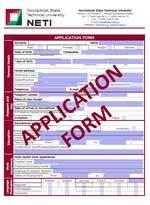
- Application Form filled in (please use only Adobe Reader for electronic filling!)
1.2.1.1. Legalization
Legalization is the process of authenticating your educational documents for use in Russia. This is typically done via an Apostille (for Hague Convention countries) or through Consular Legalization at the Russian Embassy/Consulate.
1.2.2. Wait for the positive answer
After your documents are considered, you receive either positive or negative feedback.
1.2.3. Contact NSTU NETI Center for International Education to come to Russia
In order to get an invitation to enter the Russian Federation and obtain a visa, contact NSTU NETI Center for International Education (inter@nstu.ru).
2. Waiting for the invitation
2.1. To enter the Russian Federation with a visa issued by a Russian Consulate you should have an official invitation for studying
While planning your visit to NSTU, please check whether you need a visa to enter Russia. International students from visa countries can be enrolled to NSTU NETI only under a student visa issued by the NSTU NETI invitation. Invitations to Russia are issued by the Migration Service of the Ministry of Internal Affairs of the Russian Federation and it takes 1 month. Then the invitation for the student visa will be e-mailed to the applicant by an admissions officer from the NSTU NETI Center for International Education. You will need the printed copy of the invitation to submit the visa application.
2.2. While waiting, explore Russian culture, language, national holidays, and traditions
We strongly recommend that you begin learning the Russian language, alphabet, and basic phrases in advance.
2.3. Plan your flight route
Plan the route from your city to Novosibirsk (Tolmachevo Airport) and review maps of Russia, Novosibirsk and the university.
2.4. Find information about the costs
Search for the costs of living, food, accommodation, expenses during studies and medical insurance in Novosibirsk (medical insurance can be purchased after your arrival at NSTU NETI).
2.5. Learn trivia
Learn about the geography, climate and necessary autumn/winter clothing (we recommend preparing your clothing before arrival in Novosibirsk).
2.6. Gather accommodation documents
For the dormitory accommodation you will need:
- Vaccination certificate and its notarized translation (done in Russia) if it's not Russian
- Chest X-ray (fluorography) and its notarized translation (done in Russia) if it's not Russian
- HIV negative test and its notarized translation (done in Russia) if it's not Russian
Show this in the NSTU NETI hospital (5th dormitory) to receive accommodation approval. You can have a chest X-ray taken in the hospital.
3. Obtaining a visa
3.1. Receive an invitation and submit it for a visa
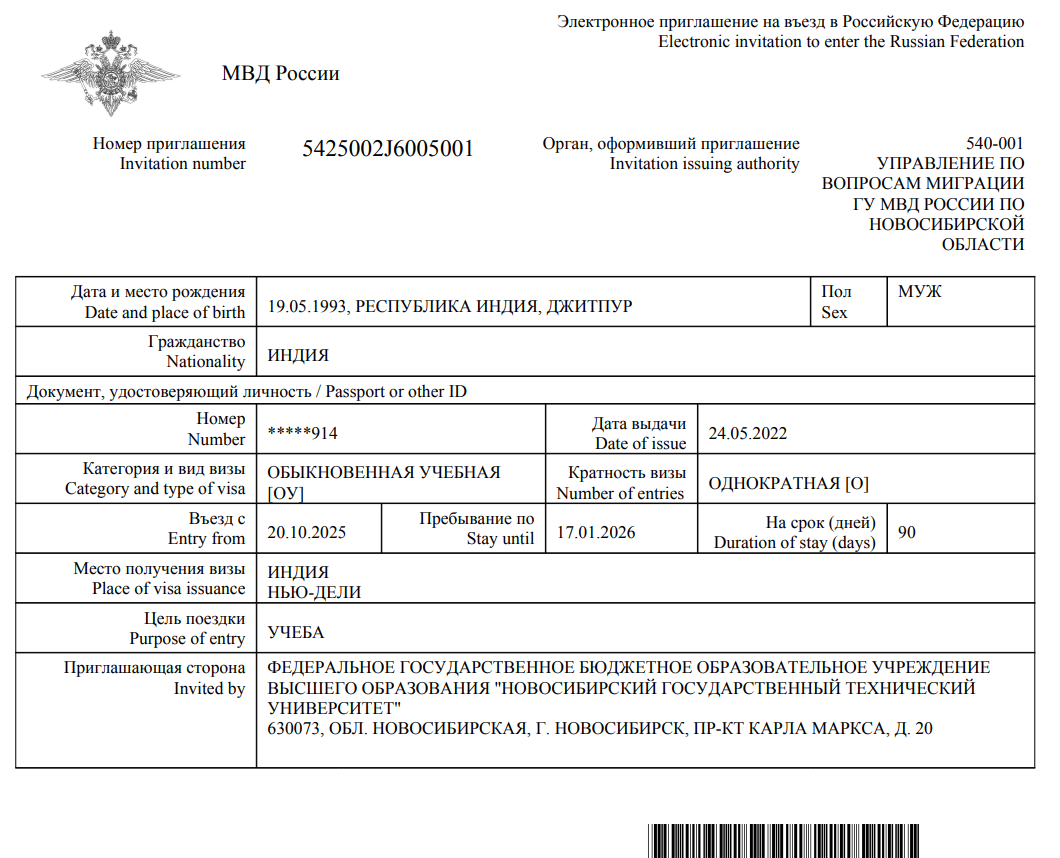
An invitation for the student visa will be e-mailed to the applicant by an admissions officer from the NSTU NETI Center for International Education. Print it and visit the Russian Embassy in the country of citizenship.
Recommendation on filling in the visa application form: NSTU NETI Telex is "614636 NSTU SU", TIN is 5404105174. Your invitation number should start from "2J..."
3.2. Receive the visa in the embassy
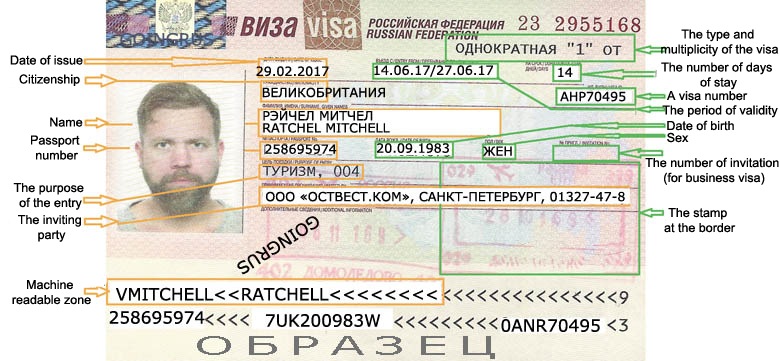
A single-entry visa allows you to enter Russia once (received in the Russian embassy), while a multiple-entry visa permits you to enter and exit Russia multiple times within its validity period (received after the extension).
3.3. Make sure to legalize your educational documents (if needed) in the Russian Embassy in the country of the documents issuing
4. Arrival to Russia
4.1. Check all the documents
Once you have obtained your student visa and legalized your educational documents, check the list of required documents that you must bring with you to NSTU NETI:
- Passport
- Notarized translation of your passport into Russian (done in Russia)
- Legalized original of your educational document with transcript (all pages)
- Notarized translation of your educational document with transcript into Russian (done in Russia)
For the dormitory accommodation you will need:
- Vaccination certificate and its notarized translation (done in Russia) if it's not Russian
- Chest X-ray (fluorography) and its notarized translation (done in Russia) if it's not Russian
- HIV negative test and its notarized translation (done in Russia) if it's not Russian
It is essential to bring the originals of all documents with you to NSTU NETI.
4.2. Buy a ticket and come to Novosibirsk
You must buy plane tickets and arrive in Novosibirsk 50 days before the visa expires. Otherwise, the visa will not be extended and you will return home. Once you have obtained your student visa to Russia and purchased your tickets to Novosibirsk, please send a scan of your ticket to inter@nstu.ru at least 7 days prior to your arrival in Novosibirsk. In your email, please include the date and time of your arrival at Novosibirsk Airport (Tolmachevo).
4.2.1. Pick up arrangement and layover
The university will arrange the airport pick-up only at Novosibirsk Airport, accompany you to the university dormitory, and assist you with check-in. If you are flying to Novosibirsk with a layover in another city, such as Moscow, the university will not meet you in the transit city. Please take this into account when planning your route to Novosibirsk, as well as the time difference (Moscow time is GMT+3, Novosibirsk time is GMT+7). Information about your route and arrival in Novosibirsk (sent to NSTU NETI) is necessary for your comfortable and convenient airport pick-up in Novosibirsk and your accommodation in the university hostel.
Please keep in touch with the university. Please note that the time difference between Novosibirsk and Moscow is 4 hours (Moscow GMT+3, Novosibirsk GMT+7).
4.3. Prepare for a flight
4.3.1. Item list
We recommend preparing the following items before your arrival:
- Electronics: power adapters for Type C/F plugs (220V); a reliable power bank; a good laptop.
- Essentials: multiple copies of all important documents (passport, visa, invitation, educational certificates).
- Basic first-aid kit with familiar, legally permitted medicines.
- Several 3x4 cm photos for administrative forms (white background).
- Sturdy backpack.
- Food: a small supply of familiar non-perishable snacks or spices from home.
- Bedding: while dormitories provide bedding, you still need your own sheets and pillowcase.
Essential mobile applications:
- Yandex Go or Uber for taxis and food delivery.
- Yandex Maps or 2GIS for navigation and public transport.
- Yandex Translate or Google Translate for language assistance.
- Sber Online or Tinkoff for mobile banking.
- Avito for buying and selling second-hand items.
- Wildberries or Ozon for online shopping.
- Telegram is the de facto standard for communication in Russia, used by everyone from student groups to university departments for announcements.
- VPN. Many Western services (Google, Instagram, Facebook, etc.) are restricted. You must install a reliable, paid VPN on all your devices before you leave home. Free VPNs are often unreliable and unsafe. This is critical for accessing academic resources, communicating with family, and general internet use.
4.3.2. Money
We recommend exchanging a small amount of money into rubles before arriving in Russia to be able to purchase food, water and a ticket (if necessary). When you arrive in Novosibirsk, you will have the opportunity to exchange money at banks in the city (dollars to rubles) with a better exchange rate. You will need your passport to exchange currency.
4.3.2.1. Reserves
Please find out in advance how you can transfer money from your country to Russia. If it is not possible to transfer money, save some money and make financial reserves in cash (dollars/rubles) that will be necessary for you to live on during your studies at NSTU NETI. International students are prohibited from working during their studies on preparatory courses (students on the main programs are able to work).
Please be advised that Russian banks don’t accept old, stained or torn dollars/euros.
4.3.2.2. Approximate outline of expenses
Tuition fee (depending on the program; should be paid for 1 semester after arrival)
Invitation fee: 10,000 rub
Accommodation: starting from 1,407 rub per month for the main programs (should be paid for 1 semester after arrival)
Living expenses: 30,000-40,000 rub per month
Medical insurance: 3,500-5,000 rub per year
Visa extension: 6,000 rub
NSTU NETI dormitory hospital (5th dormitory) chest X-ray: 1,500 rub
NSTU NETI dormitory hospital (5th dormitory) accommodation approval: 500 rub
Medical examination: 13,000 rub per year
Fingerprinting: 1,500 rub
Recognition of educational documents (if needed): 9,000 rub
4.3.3. Health insurance
While you can purchase it upon arrival, it is highly recommended to have at least short-term travel health insurance that covers you from the moment you land until you can buy the Russian policy. If you take any prescription medication, bring a sufficient supply and carry the original prescription and a doctor's note translated into Russian to avoid issues at customs.
4.3.4. SIM cards for tourists and students
Having a working mobile connection upon arrival is critical for safety, navigation and contacting the university. Your home country's SIM will likely not work. For long-term stays, Russian law requires full identification for a SIM card. This process involves getting a SNILS number, registering on the Gosuslugi portal and submitting biometrics, which can take 1-3 weeks. During this time, your new Russian SIM will have limited functionality.
Tourist eSIM is the most convenient and immediate solution. You can arrange it before you leave your home country. An eSIM is a digital SIM embedded in your phone. You purchase a plan online and receive a QR code to activate it. It can be activated the moment you land, giving you instant access to data for maps, translation and contacting the university volunteer. This avoids the stress of finding a physical SIM at the airport.
4.4. Receive information about the pick up
After sending tickets to NSTU NETI Center for International Education, a volunteer should be dispatched to pick you up. Receive the number of the volunteer.
4.5. Cross the border
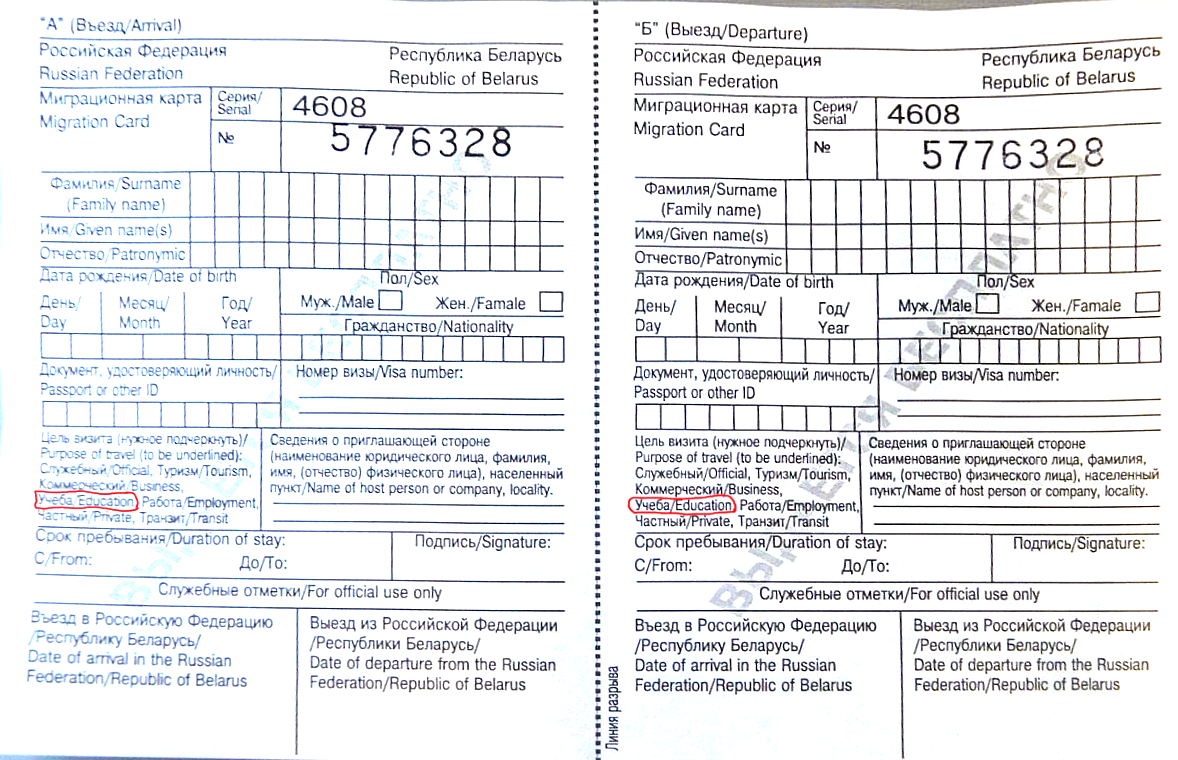
At the border you will be given a migration card. You must fill out two identical parts. The border officer will keep the Arrival part and stamp the Departure part, then return it to you. Do not lose this card. You must keep the original part (with the stamp) for your entire stay in Russia. You will need it for registration, visa extension and when leaving the country. Take a picture/scan of it immediately as a backup.
The purpose of the migration card entry should be Education only!. Otherwise your migration registration cannot be done.
Your migration card will be taken upon leaving the Russian Federation and you will receive a new one after crossing the border into the Russian Federation again.
5. Arrival to NSTU NETI
5.1. Do a migration registration
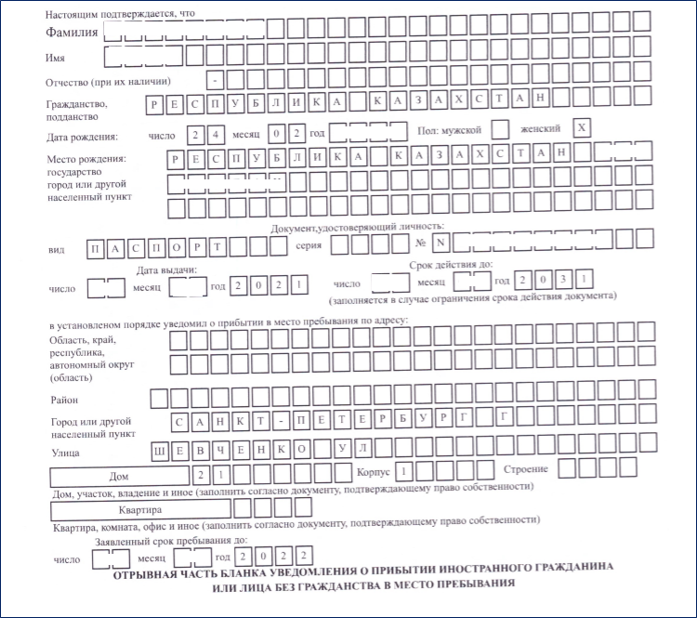
Once you have arrived in Novosibirsk and are accommodated into the university, you need to visit the International Office of NSTU NETI to register and receive instructions on visa extension (not later than 2 days after arrival). Upon arrival to Russia all international students must perform registration with the Federal Migration Service, if the duration of stay in Russia exceeds 7 calendar days. Please submit the below-listed documents within 2 working days to the Center for International Education:
- Passport first page copy
- Copy of the single-entry visa
- Migration card and its copy
Should you stay in a hotel/hostel in Russia or move from the dormitory to a private apartment, or leave Novosibirsk or the territory of Russia, your registration will become invalid. Every time you re-enter Russia or change your permanent address (even moving to a different dormitory), you must re-register within 7 days. This is a strict migration rule. Failure to do so results in fines or deportation. When you travel, take your passport, migration card and visa with you. Inform the International Office immediately upon your return.
Take a picture/scan of your registration after receival as a backup.
5.1.1. Private address registration
NSTU NETI does not register students at private addresses. Registration must be done at the local Ministry of Internal Affairs (MVD) migration office or at Gosuslugi website with the apartment owner. A list of required documents (including the owner's passport and proof of property) must be provided. NSTU NETI will supply you with the registration request (ходатайство) and enrollment confirmation (справка об обучении).
5.2. Check-in
5.2.1. Sign the educational contract
Visit the Center for International Education (1st building, room 338) to sign your contract and fill in all papers.
5.2.2. Receive your class schedule
Visit the Center for International Education (1st building, room 338) to receive your schedule or to find out the group number for the main program (you can check your schedule here: https://www.nstu.ru/studies/schedule/schedule_classes).
5.2.3. Purchase medical insurance for the academic year
All international students arriving at NSTU NETI must have a medical insurance valid for the period of stay in Russia. Health insurance for international students must include:
- Emergency ambulance and medical care
- Emergency inpatient care
- Emergency outpatient care
- Laboratory tests
- Medical examination
- Medical transportation and repatriation services.
The amount of insurance coverage must be not less than 100 000 roubles. If your medical insurance expired during your studies at NSTU NETI or you did not purchase it in advance, you may order it from the insurance companies that cooperate with the NSTU NETI clinic (visit 1st building, room 338).
5.2.4. Pay the invitation fee
If your invitation was issued by NSTU NETI (not by the Ministry of Education of the Russian Federation), you need to pay the invitation fee.
5.3. Dormitory
5.3.1. Receive dormitory contract
Receive the accommodation contract and further instructions (visit 1st building, room 338). International students may get accommodation in the NSTU NETI dormitories or rent apartments.
For the dormitory accommodation you will need:
- Vaccination certificate and its notarized translation (done in Russia) if it's not Russian
- Chest X-ray (fluorography) and its notarized translation (done in Russia) if it's not Russian
- HIV negative test and its notarized translation (done in Russia) if it's not Russian
- It is essential to bring the originals of all documents with you to NSTU NETI.
5.3.2. Life in the dormitory (Obshchezhitiye)
Dormitories are a classic Russian student experience. They are functional and a great way to meet people, but they come with rules.
Curfews. Often exist (e.g., 11 PM or later). Find out the rule for your specific dorm.
Komendant (Commandant). The dorm manager is a key figure. Maintain a good relationship with them.
Shared facilities. Kitchens and bathrooms are often shared by a floor or wing. Be clean and respectful.
Roommates. You will likely have 1-3 roommates. Be open-minded and establish clear communication from the start.
Security. You will need your entrance pass (temporary, if the permanent one hasn’t been received) to get in and out.
5.4. Receive NSTU NETI WiFi login and password (visit 1st building, room 338)
6. Educational process
6.1. Main programs educational process
6.1.1. While waiting for the registration, get to classes
The university follows the Russian higher education system, which includes lectures, practical classes, laboratory work, and independent study. Below are key components of the academic process.
6.1.2. Types of classes
Lectures (Lekzii, Лекции): theoretical classes where professors present course material. Attendance is often mandatory.
Seminars/Practical Classes (Seminary, Семинары and Prakticheskie zanyatiya, Практические занятия): focus on problemsolving, discussions, and applying theoretical knowledge. Active participation is expected.
Laboratory Work (Laboratornye raboty, Лабораторные работы or simply Laba, Лаба): hands-on experiments or projects conducted in labs. Students must complete lab reports.
Independent Study: Self-paced learning, including homework, research, and preparation for exams.
6.1.3. Assessment system
Zachot (Зачёт): a pass/fail assessment for non-core subjects or practical work. No grade is given; the student either receives "pass" (зачтено) or "fail" (не зачтено). Requirements: attendance, completed lab work, a small test.
Exams (Экзамены): Graded assessments (on a 5-point scale & ECTS scale) for core subjects at the end of each semester.
Format: Oral, written, or combined (e.g., written test and oral defense).
6.1.4. Key academic terms
Session (Сессия): exam period held twice a year (winter and summer). Students must pass all exams to advance.
Academic Debts (Академические задолженности or simply Dolgi, Долги): failed exams or missed assignments must be retaken within a set period.
Coursework (Курсовая работа or simply Kursach, Курсач): a research or practical project submitted annually in most programs.
Auto (Автомат, Automatic Pass): some professors grant a pass (zachot, зачёт) or exam grade without a final test if a student attends all classes and performs well during the semester. Ask your professor about this possibility.
Bilet (Билет, Exam Ticket): in oral exams, students draw random "tickets" with 2–3 questions to prepare a short answer on the spot.
The Record Book (Зачетная книжка, Zachotnaya Knizhka or simply Zachotka, Зачетка): this is a small paper booklet where all your passed exams and zachots are officially stamped and signed by the professor. You must present it to the professor after each exam to get your grade recorded.
6.1.5. Defense of graduation qualification work
The ВКР (VKR – Final State Attestation) is a mandatory research or applied project required to complete a bachelor’s, specialist’s, or master’s degree at NSTU NETI. It demonstrates a student’s ability to conduct independent work in their field.
6.1.5.1. Preparation
Topic Selection: assigned by the department or chosen by the student (approved by a supervisor). Topics are usually finalized by the start of the final year.
Supervisor (Научный руководитель or simply Nauchruk, Научрук): a professor or PhD from the department guides the research, reviews drafts, and approves the final version.
Structure: follows strict formatting (GOST standards). Typically includes: title page, abstract (in Russian/English), table of contents, introduction, theoretical/practical chapters, conclusion, bibliography, appendices.
Plagiarism Check: ВКР must pass anti-plagiarism review (typically ≥65-70% originality).
6.1.5.2. Submission deadlines
Draft submissions to the supervisor occur 2-3 months before defense. Final version must be submitted 1 month before
defense for review by the department and external evaluators (if required).
6.1.5.3. Pre-defense requirements
Review (Рецензирование): an external reviewer (often a professor or industry expert) evaluates the ВКР and writes a review (retzenzia, рецензия).
Defense Materials: printed copy of ВКР (bound), presentation slides (10–15 min, covering: relevance, goals, methods, results, conclusions),. handouts (optional but recommended for the committee).
6.1.5.4. Defense procedure
Committee (GAK, ГАК – Государственная аттестационная комиссия) composed of professors, industry experts, and department heads.
Steps:
Presentation: student presents key points (strict time limit). Questions: committee asks about methodology, results, or
theoretical foundations. Reviewer’s Feedback: the reviewer’s evaluation is read aloud. Supervisor’s Remarks: supervisor may
comment on the student’s progress. Closed Deliberation: committee votes on the grade (5-point scale & ECTS scale).
6.1.5.5. Grading criteria
Scientific rigor: depth of analysis, originality. Practical significance: applicability to real-world problems. Defense performance: clarity, ability to answer questions. Formatting compliance: adherence to GOST/university standards.
7. Entrance pass and transport card
7.1. Entrance pass for main programs students
7.1.1. Temporary entrance pass
Log in to your personal account, open the Personal data (Личные данные) section, click on the Upload photo (Загрузить фотографию) button, click on the Check photo (Проверить фотографию) button. After checking the photo, the Download (Скачать) button will appear at the bottom. Download the temporary entrance pass.
7.1.2. Permanent entrance pass
Fill in the entrance pass application in your personal account (see 1.1.7). Go to the Levoberezhny (Левобережный) bank and receive a card. It is either an entrance pass card and your bank card.
7.2. Entrance pass for preparatory programs students
7.2.1. Pay 500 rubles in the Cash Office (1st building, room 128), get the payment receipt.
7.2.2. Receive your dormitory contract (1st building, room 338)
7.2.3. With the receipt and your dormitory contract visit the Campus Directorate (7th dormitory, room 4) or the Entrance Division (1st building, room 112) to make the entrance card.
7.3. If you need the transport card
7.3.1. Enter information about your SNILS in the personal account
7.3.2. Wait for the information on the Transport card page to be updated
On the page Документы > Транспортная карта of your personal account there should be a message that your SNILS has been transferred to the Novosibirsk Ministry of Digital Development and Communications.
7.3.3. Register on the website: https://karta.nso.ru, fill out a card application, attach your photo in your personal account and link your bank card there
8. SIM-card activation and SNILS
Buying a Russian SIM card means waiting till it is activated. In some cases it cannot be sold without getting SNILS and submitting biometrics.
If you’re under 18 years old, you cannot submit the biometrics and therefore activate a SIM card.
8.1. Receive your registration at the NSTU NETI Center for International Education (1st building, room 338)
8.2. Get the SNILS
Apply through the МФЦ (Multifunctional Center). Search for My Documents office (МФЦ), use the Novosibirsk map in the 2Gis app for better orientation. You will need 4 documents: passport, notarized translation of passport (done in Russia), registration, migration card.
Acquire the SNILS number. Create and activate a Public Services (Gosuslugi, Госуслуги) account.
8.3. Submit your biometrics
Go to the bank to register in the Unified Biometric System. You will need 5 documents: passport, notarized translation of passport (done in Russia), registration, migration card, SNILS.
If you’re under 18 years old, you cannot submit the biometrics and therefore activate a SIM card.
8.4. Activate the SIM card with your SIM operator
9. Annual medical examination
9.1. Receive your registration at the NSTU NETI Center for International Education (1st building, room 338)
9.2. Undergo a medical examination
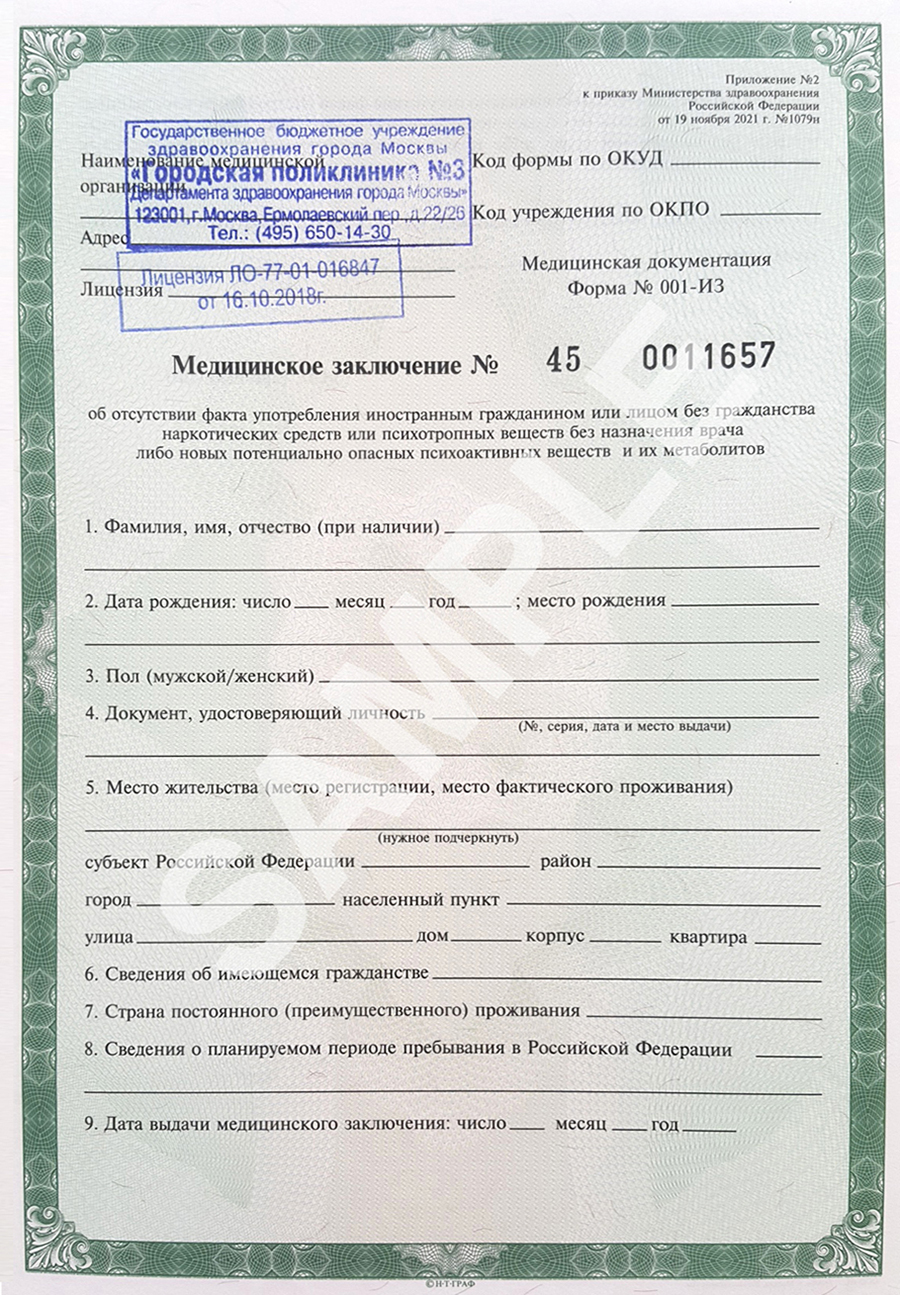
The medical examination and fingerprinting are legally mandatory for all foreign citizens staying in Russia for more than 90 days. Failure to complete these procedures within 90 days of entry (see your migration card for the entry date) will result in fines and potential deportation. The medical certificate can be obtained in licensed medical institutions.
9.3. Submit your medical certificates (after second year medical examination)
If you undertake annual medical examination for the second time while in Russia, you need to submit your results copies to Esenina St., 1g (2nd floor).
10. Fingerprint registration (dactyloscopy)
10.1. Receive medical examination certificates
10.2. Visit the fingerprinting center
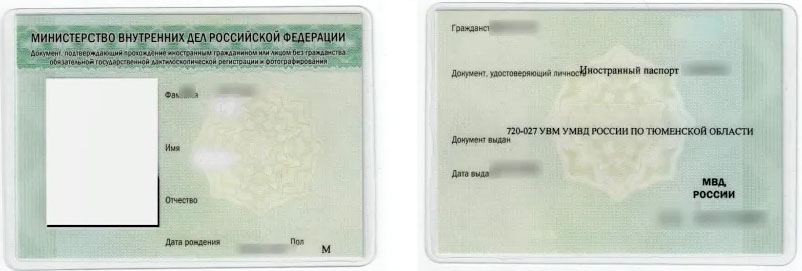
After the medical examination it is necessary to undergo a fingerprinting procedure (to be passed only once). The address is Esenina St., 1g. To undergo dactyloscopy (fingerprinting procedure) you must have:
- Medical certificates
- Passport
- Migration card
- Registration
- Notarized passport translation (done in Russia)
- Enrollment confirmation (справка об обучении) for those under 18 years old
10.3. Receive the card
11. Visa extension and legal status (RVPO)
11.1. Gather documents
Student visa is always issued as a single-entry 90-days visa first. Then it may be extended for the period of study at the University. For visa extension and obtaining a new multiple visa submit the below-listed documents to the Center for International Education (1st building, room 338) no later than 45 days before the expiration date of your current visa:
- Passport, which should be valid for a minimum period of 18 months from the issue date of your visa and contains at least two blank pages
- Copies of all (even blank) passport pages
- Migration card (original and copy) (see 4.5)
- 3x4 cm photo (white background)
- State fee receipt (original and copy) of 6,000 rubles
- Registration (original and copy)
- Educational contract (original and copy) for contract-based students
11.2. Submit your passport for a visa extension submission stamp
You can receive your passport back with the stamp given.
11.3. Wait 20 working days and submit your passport back
You will receive your passport back with the new visa. It will be extended for the maximum of 1 year (not longer than the educational contract).
You will receive the new registration according to your new visa afterwards.
11.4. RVPO legal status
While studying on the main program you can obtain Residence Permit for Education (RVPO). This will allow you to receive a visa for the whole period of study + the next 180 calendar days after the end of the study period.
List of documents needed:
- Passport (identity document valid for at least 3 months) with its notarized translation (done in Russia)
- Migration card
- Registration (see 5.1)
- State duty payment receipt
- Medical certificates (see 9)
- Police clearance certificate and (if needed) its legalization
- Spravka U-30 (get in in your Dean’s office)
- Extract from the enrollment order (get it in your Dean’s office)
- 2 photos (35 x 45 mm)
- NSTU NETI accreditation and license (https://www.nstu.ru/university/info/document; signed by the Dean and stamped).
Documents written in a foreign language must have notarized translation into Russian (done in Russia).
All documents are to be submitted to Esenina St., 1g (2nd floor).
11.4.1. PRVO advantages
If a foreign citizen arrives on a visa basis, he will be issued a multiple-entry visa for the period of validity of the RVPO.
There is no obligation to submit an annual notification confirming residence in the Russian Federation, unlike other legal statuses of residence.
A student who has received an RVPO will be able to stay in the Russian Federation for the entire duration of his studies and after completing his studies for another six months, during which he can apply for a residence permit without leaving the Russian Federation.
The opportunity to apply for a residence permit is also provided for three years after completing the studies without obtaining a temporary residence permit.
Proof of proficiency in the Russian language, knowledge of the history and fundamentals of the legislation of the Russian Federation is not required.
A foreign citizen temporarily residing in his own home can register at his place of residence for the entire period of validity of the RVPO. The migration registration procedure is applied in case of absence of a place of residence or departure from the region of the RVPO obtaining.
RVPO foreign citizens are not required to undergo annual medical examinations.
A foreign citizen temporarily residing has the right to social support, including free medical care in state medical institutions.
11.4.2. PRVO disadvantages
International students can live and work only in the region where the RVPO was issued.
The total period of stay of the RVPO foreign citizen outside of Russia may not exceed 6 months during a calendar year without a valid reason.
Upon transfer to a part-time education or early termination of studies the RVPO is canceled.
12. Register of controlled persons
In case of bank card blocking or inclusion in the Register of Controlled Persons (РКЛ) you must immediately contact the Center for International Education (1st building, room 338). You can check your status in the Register via the link: https://xn--b1aew.xn--p1ai/rkl. This register includes individuals who have violated Russian migration law (e.g., overstayed a visa, failed to register, provided false information). Inclusion can lead to fines, deportation, and entry bans.
If you got included into the Register of controlled persons while you have valid visa, migration registration and medical certificates, please write an application to the district migration office of the Ministry of Internal Affairs.
You will need copies of all your documents. While your bank cards are blocked if you're included into the Register of controlled persons, you still can deposit the money with your bank officer physically.
13. Critical timeline
50 days before visa expiry: arrive in Novosibirsk.
45 days before visa expiry: submit documents for visa extension to the International Office.
Within 2 working days of arrival: do migration registration at the university.
Within 90 days of entry: complete mandatory medical examination and fingerprinting.
14. Do Not Lose list
- Passport (obviously)
- Migration card (the stamped departure part)
- Registration (every time you get a new one)
- Honeymoon phase: the first few weeks are often filled with excitement and curiosity about everything new.
- Negotiation phase (The "Shock"): after a month or two, differences in language, food, weather, and social norms can become frustrating and lead to homesickness, irritability, or fatigue. This is normal and temporary.
- Adjustment phase: you gradually develop a routine, learn more of the language, and start to feel more comfortable and independent.
- Adaptation phase: you feel at home in Novosibirsk, can navigate daily life with confidence, and appreciate both the differences and similarities between your home culture and Russia.
- Здравствуйте (Zdravstvuyte) – Hello (formal)
- Привет (Privet) – Hi (informal)
- Спасибо (Spasibo) – Thank you
- Пожалуйста (Pozhaluysta) – Please / You're welcome
- Извините (Izvinite) – Excuse me / I'm sorry (formal)
- Простите (Prostite) – Sorry (stronger)
- Да (Da) – Yes
- Нет (Net) – No
- Я студент НГТУ (Ya student NGTU) – I am an NSTU student.
- Я не понимаю (Ya ne ponimayu) – I don't understand.
- Повторите, пожалуйста (Povtorite, pozhaluysta) – Can you repeat that, please?
- Где...? (Gde...?) – Where is...?
- Где общежитие? (Gde obshchezhitiye?) – Where is the dormitory?
- Где метро? (Gde metro?) – Where is the metro?
- Мне нужна помощь (Mne nuzhna pomoshch) – I need help.
- Скажите, пожалуйста... (Skazhite, pozhaluysta...) – Tell me, please... (a polite way to start a question)
- Сколько стоит? (Skol'ko stoit?) – How much does it cost?
- Это что? (Eto chto?) – What is this?
- Можно картой? (Mozhno kartoy?) – Can I pay by card?
- Дайте, пожалуйста... (Dayte, pozhaluysta...) – Give me, please... (e.g., ...этот хлеб / ...that bread)
- Чек, пожалуйста (Chek, pozhaluysta) – The bill, please.
- Где аудитория...? (Gde auditoriya...?) – Where is the lecture hall...?
- У меня вопрос (U menya vopros) – I have a question.
- Что задано? (Chto zadano?) – What is the homework?
- Когда экзамен? (Kogda ekzamen?) – When is the exam?
15. Culture shock and adaptation
Moving to a new country is an exciting adventure, but it is normal to experience culture shock – a feeling of disorientation and anxiety in an unfamiliar environment. Understanding this process and knowing how to cope will make your transition much smoother.
15.1. Four phases
Be aware that adaptation often happens in waves:
15.2. Practical tips for adaptation
15.2.1. Be proactive socially
Don't isolate yourself. The number one way to combat loneliness and improve your Russian is to connect with others.
Join student clubs. NSTU NETI has various student groups (sports, music, dance, science, interclub). This is the easiest way to meet Russian and international students with similar interests.
Participate in university events. Attend festivals, concerts, and open days organized by the university.
Use language tandem apps. Find a language partner who wants to learn your language in exchange for practicing Russian with you.
15.2.2. Understand the bureaucracy
Russian administrative processes can be slow and require specific paperwork.
Patience is a virtue: always be polite and patient with university staff and officials. Getting angry will not speed things up.
Double-check everything: when submitting documents, ask the International Office to check if you have everything. A missing stamp or copy can cause significant delays.
Not today (Segodnya nyet): be prepared for the answer "not today" or "come back tomorrow." This is not a refusal, just a part of the process.
15.2.3. Navigate the language barrier
Russians are generally helpful. While strangers may not smile freely, most are willing to help if you ask. A simple "Izvinite, pomogite pozhaluysta?" (Excuse me, could you help me please?) goes a long way. Practice basic phrases daily. Don't be afraid to make mistakes. Using even broken Russian in shops or on transport is respected and is the fastest way to learn. Use technology. Your translation app is your best friend initially. Download offline packs for Russian.
15.2.4. Food and dietary needs
Halal food: there are specialized halal butchers and shops in Novosibirsk. Look for areas with larger communities from Central Asia and the Caucasus. You can also find halal meat sections in some larger supermarkets.
Vegetarian food: traditional Russian cuisine is meat-heavy, but vegetarian options are increasingly available.
In cafeterias: look for dishes like "kasha" (porridge), "bliny" (pancakes), "sirniki" (cheese pancakes), "vareniki" with potato or cabbage, and salads.
Supermarkets: large chains like "Magnit" "Perekrestok", "Pyaterochka" and "Lenta" have good selections of fresh vegetables, fruits, legumes, dairy, and imported goods. "Azbuka Vkusa" and "VkusVill" are higher-end supermarkets with good international and vegetarian options.
Restaurants: most restaurants in the city center now have vegetarian options. Look for Georgian cuisine, which has many excellent vegetarian dishes.
16. Useful Russian phrases
Knowing a few key phrases will greatly improve your daily life and help you connect with people. Practice these before you arrive.
16.1. Essentials
16.2. For getting help and directions
16.3. In a shop or a cafe
16.4. At the university