
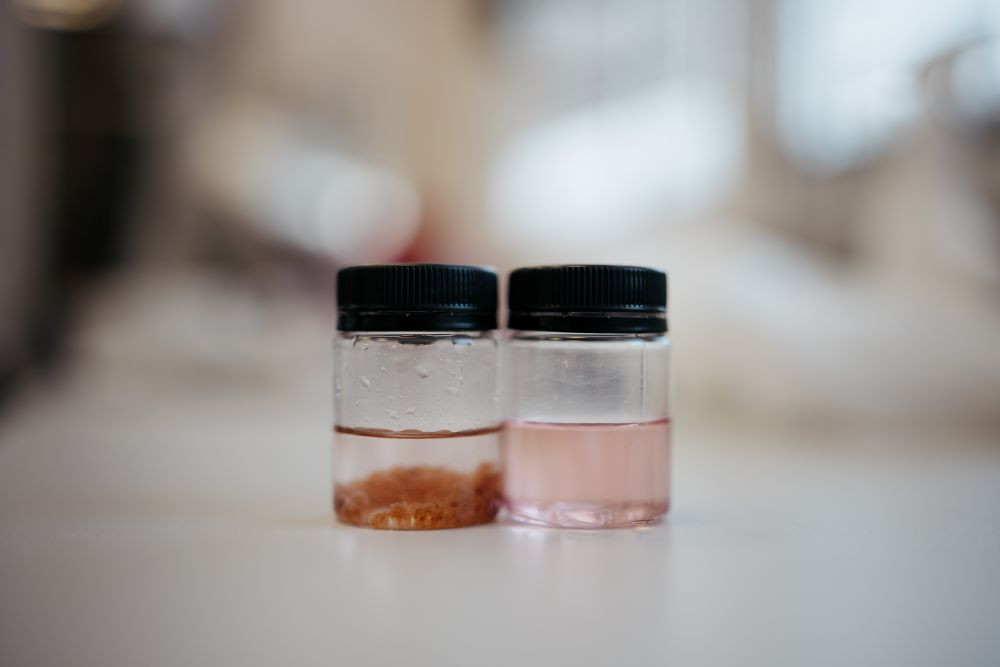
Scientists from Novosibirsk State Technical University (NSTU) have synthesized cryogel based on carboxyethyl chitosan, assessed its adsorption capacity and potential for practical use in the field of water treatment. The work is carried out within the framework of the project "Modular technologies in the production of raw components of biopolymers", which is being implemented with the support of the Priority 2030 program.
Cryogels of carboxyethyl chitosan were synthesized using cryotechnology, when a reaction mass containing a biopolymer and a crosslinking agent was placed in a freezer and kept at temperatures from -19 ° C to -80 ° C for several days, during which the water freezes and the crosslinking of biopolymer chains occurs around ice crystals. In this case, the freezing water forms a macroporous framework, which, after thawing the ice and removing the water, provides high mechanical strength, elasticity and permeability of the polymer material.
The structure of the obtained samples was confirmed by IR spectroscopy, elemental analysis, and scanning electron microscopy. Further, studies of the degree of swelling and porosity of the gels were carried out in the laboratory. According to the project manager, Candidate of Pharmaceutical Sciences Alexander Drannikov, an increase in porosity was observed with an increase in the holding time and a decrease in the cryotherapy temperature. The scientist emphasized the importance of selecting optimal cryoprocess parameters, which directly affect such characteristics as specific surface area, volume and pore size. Depending on the conditions, the parameters of the final product can vary radically and can be optimized depending on the final use of the adsorbent.
At the next stage, the scientists evaluated the adsorption capacity of cryogels. The samples were placed in solutions of cobalt nitrate and potassium dichromate and held for a certain time, after which the concentration of heavy metal ions was measured on a spectrophotometer to analyze the kinetics (rate) of adsorption.
"According to the results of laboratory tests, cryogel has shown high efficiency in metal bonding, due to its developed surface and chemical structure. In the future, it is planned to test the adsorbent in a dynamic mode, when water purification will be carried out by passing through a sorbent layer. To effectively remove metal ions from the water at a given flow rate, it is critically important to calculate the optimal amount of gel, which contributes to the efficient flow of water and at the same time the capture of heavy metal ions. In addition, the ability of the adsorbent to regenerate for repeated use will be investigated," said Alexander Drannikov.
The scientist emphasized that the synthesized cryogel opens up opportunities for creating a new generation of sorption materials combining high efficiency, environmental safety and economic feasibility, which makes them in demand both for solving current water treatment problems and for promising developments in the field of water resources protection.
The development corresponds to the goals and objectives of the national project "Technological support of Bioeconomics". The raw materials for the research were provided by the Novosibirsk partner company Chitopolymer, which produces chitosan and its modifications.