
Scientists from the Faculty of Physics and Technology and the Faculty of Radio Engineering and Electronics, NSTU-NETI, presented at international conferences the first research results obtained in the framework of a new direction in world science — cryogenic photonics. In this area, they are studying various physico-technical aspects of the quantum interaction of optical radiation with optical structures and the functioning of photonic devices at extremely low temperatures close to absolute zero.
Traditional international scientific events: "MPLP-2026 Symposium" and "International Fiber Seminar" in late August — early September in Akademgorodok were the venues where they presented the preliminary results of a unique interdisciplinary study conducted by a joint group of scientists from the Laboratory of General and Applied Photonics and the Laboratory of Quantum Cryogenic Electronics of the University.
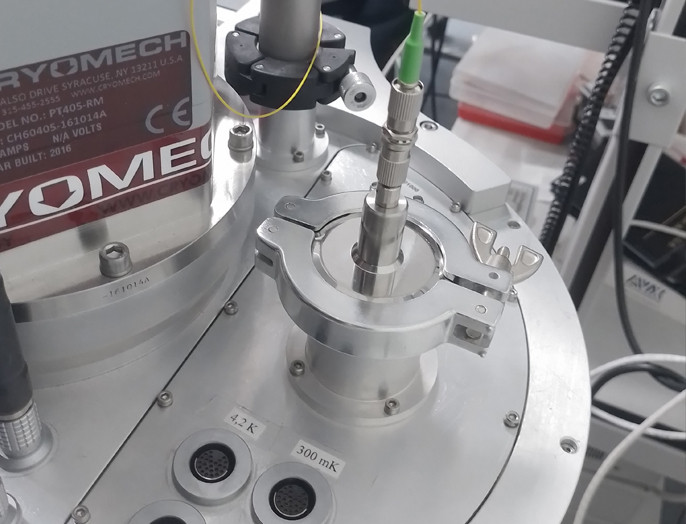
The experience and competencies in the field of photonic technologies and cryogenic electronics have made it possible to create a unique scientific and technical reserve at NSTU-NETI. The team of scientists created a unique experimental installation based on a helium-cooled vacuum refrigerator, which was equipped not only with electrical and ultra-high-frequency signal input/output lines, but also with through-fiber optic lines connecting external measuring equipment with objects studied in cryogenic conditions.
Such unique experimental equipment has been successfully tested and now allows NSTU-NETI scientists to conduct unique research and develop various cryogenic photonic devices, as well as study the properties of physical objects using optical methods at temperatures close to absolute zero — that is, below 4 K, or minus 269 degrees Celsius.
As Boris Nyushkov, head of the Department of Laser Systems and Head of the Laboratory of General and Applied Photonics, NSTU-NETI, explained, as the temperature approaches absolute zero, the characteristics of optical materials, the effectiveness of nonlinear optical phenomena, and the nature of various quantum processes can radically change.
"This opens up completely new opportunities not only for fundamental research, but also allows for the potential development of cryogenic photonic devices in the interests of space instrumentation, instrumental astrophysical research, quantum cryptography and quantum computing. In particular, it was the first time in the world, when scientists have demonstrated the possibility and features of the functioning of an all—fiber cryogenic laser at such a low temperature.
Alexey Vostretsov, head of the Laboratory of Quantum and Cryogenic Electronics at NSTU-NETI, explained that a team of scientists is currently working on creating a multiplexed photonic interface that would allow simultaneous manipulation of several superconducting qubits, the basic elements of storing quantum information and quantum logic. "The solution to this problem is in the global trend of improving the architecture of quantum computers based on superconductors," Alexey Vostretsov emphasized.