
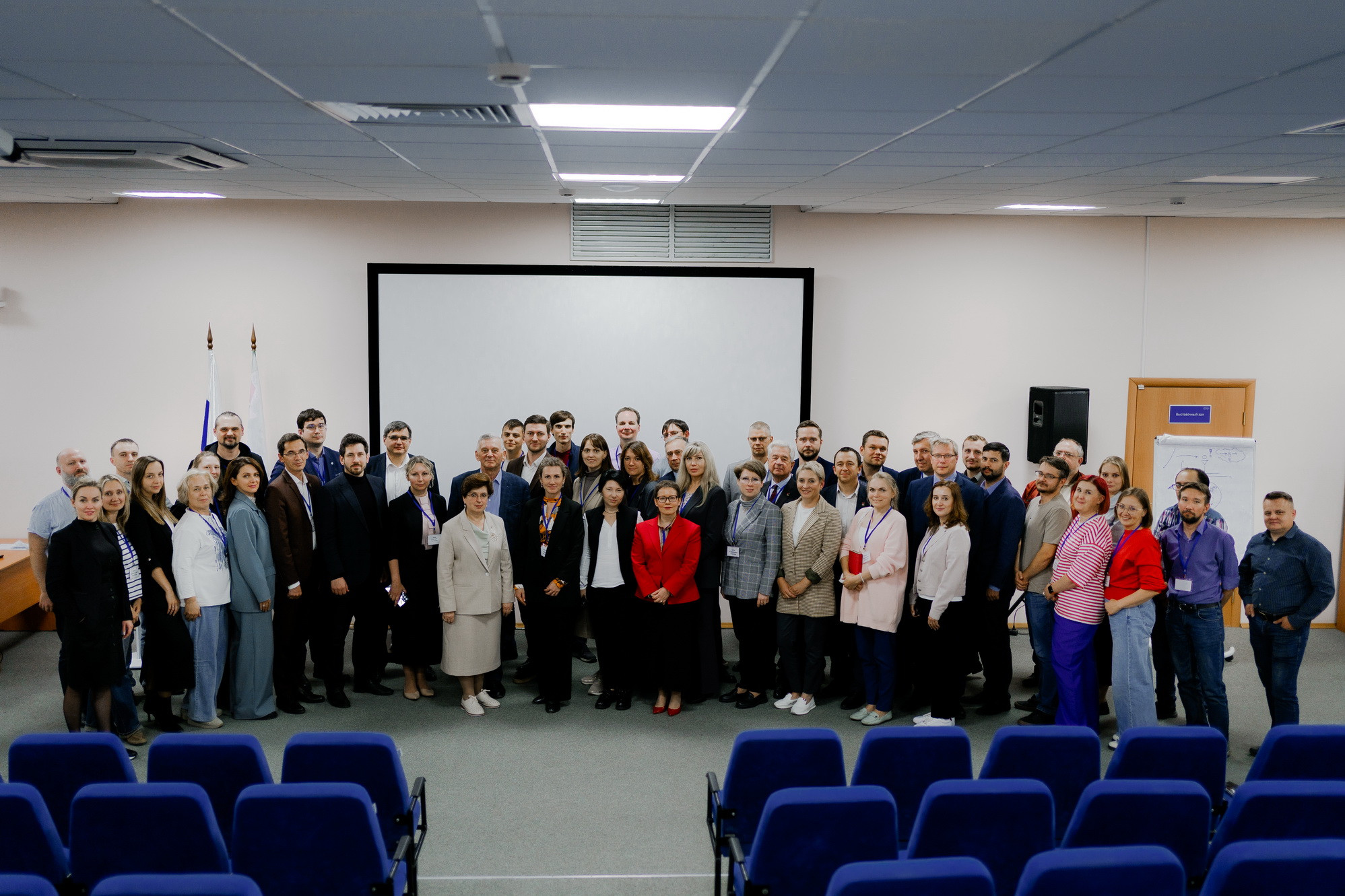
On September 15 and 16, the transformation team of Novosibirsk State Technical University (NSTU), together with experts from universities and research organizations, analyzed the results and promising areas of the university's activities in terms of compliance with strategic objectives and a targeted image of the future.
For the first time, cross-university expertise is being implemented in the country on the initiative of the Ministry of Science and Higher Education of the Russian Federation. The purpose of the examination is to provide an independent and objective assessment of the implementation of the development programs of the universities participating in the Priority 2030 program. The pool of experts was formed based on the results of a competitive selection. The objectives of the project are the mutual assessment of university development plans by equal participants, the identification of best practices, increasing the transparency of expert activities and the formation of a university expert community.
NSTU-NETI has been a participant in the Priority 2030 program since 2021. During this time, more than 80 projects have received the necessary resources for development. The University implements three strategic technological projects within the framework of the Priority 2030 program: "Power Electronics and Intelligent Energy" (purpose: to ensure the technological leadership and technological sovereignty of the Russian Federation in the fields of power electronics and intelligent energy systems, to improve the research and production model "science — universities — business"); "New materials for breakthrough technologies" (purpose: to ensure excellence in technologies for the creation and practical application of new materials with unique properties for the global competitiveness of the Russian Federation); "New engineering solutions and artificial intelligence for the medical industry" (purpose: to bring to the Russian market its own biotechnological, engineering and IT developments for the needs of crop production, veterinary, sanitary - hygiene, cosmetology and medicine).
The cross-university examination was conducted at NSTU-NETI in five areas: "University model and strategic goals" and "Technological leadership through STP" (expert of FGANU "Sociocenter" Alexey Kuzmin), "Educational policy" (expert of FGANU "Sociocenter" Anna Budarina), "Management of the development program" (expert of FGANU "Sociocenter" Olga Kucherova) and "Personnel training system" (expert FSUE "Sociocenter" Olga Rubleva). For two days, the university's team, which included more than 60 people, including university management, managers and participants of strategic technology projects, and employees of administrative departments, worked with Sociocenter experts.
Anatoly Bataev, Rector of NSTU-NETI, thanked the university team for their fruitful work within the framework of the cross-university expertise of the development program, noting that most of the university's employees are involved in its implementation: "One of the main indicators of the successful implementation of the development program for me is the proportion of young people who are involved in work on strategic technological and other projects. Today, this figure is approaching the planned 40%. The attractiveness of the university for our young generation, for applicants, is extremely important for us, so that young people want to enroll and study at NSTU-NETI. To do this, we must take a leadership position, effectively building all the necessary processes, primarily educational and research ones."
Field cross-university expertise plays a key role in the analysis of university resources, the implementation of their strategic projects and changes the approach to expert work. The vertical control system is being replaced by a developing professional community, where quality standards and specific work solutions are jointly developed, experience is exchanged, and best practices are transferred from peer to peer. Thus, expert assessment becomes not a control tool, but a resource for development.
"Novosibirsk State Technical University is a university with a rich history and strong competencies in applied areas related to the development of advanced innovative products. When solving ambitious tasks, the university faces a number of classic development issues, for example, how to build business processes. The task of the cross-university examination is to discuss specific solutions and steps that will help move forward. Our common goal based on the results of the work is to get a roadmap with clearly defined priorities, which the university will implement in the medium and long term," said Alexey Kuzmin, head of the expert group.
Irina Manuylova, Deputy Governor of the Novosibirsk Region, took part in summing up the results of the two-day work of the university team and the expert group, stressing that similar strategic sessions within the framework of the Priority 2030 program should be held within the framework of the university's current activities. The Vice Governor outlined the directions of the region's work in the implementation of national projects to ensure technological leadership and noted the role of the university in this work: "NSTU is a leading university in the Novosibirsk region, training personnel for the economy of not only the region, but also the country as a whole. Today it is not enough to be satisfied with the fact that we are moving forward step by step. If we talk about strategic projects, they should always be proactive, in the context of strategic leadership, and not just import substitution. NSTU-NETI is a team that is able to equate education, research and innovation. The university team needs to think about this when implementing their projects, and it is necessary to educate the younger generations in this spirit."
Since 2025, the Russian Ministry of Education and Science's Priority 2030 program has been implemented as part of the federal project "Universities for a Generation of Leaders" of the national Youth and Children project.