
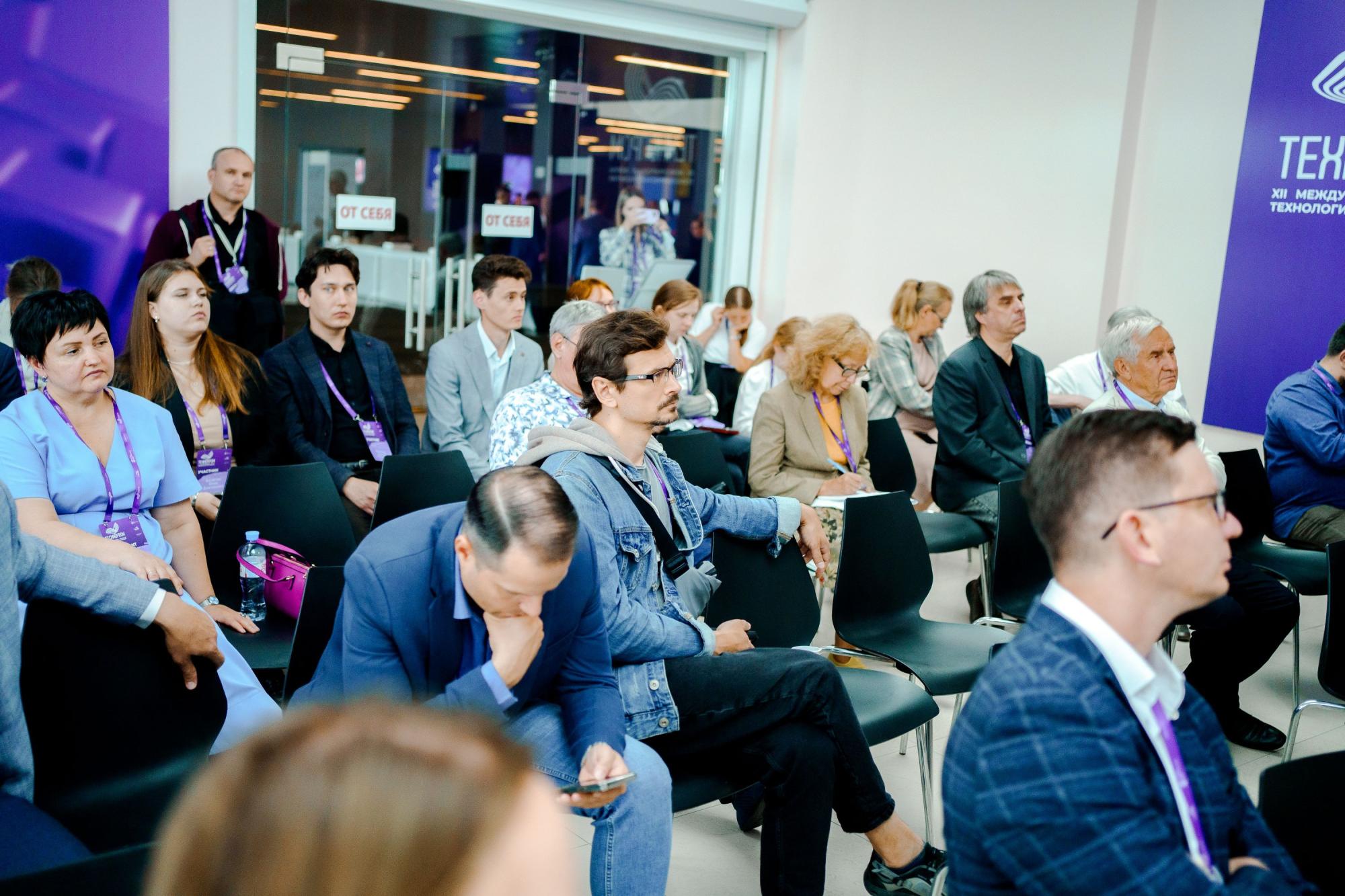
A round table of the Interuniversity Consortium for Cooperation with the SKIF CCP, dedicated to the development of a concept for the educational activities of an industry association using the capabilities of the Megascience installation, was held on August 28, 2025, as part of the Technoprom-2025 International Forum for Technological Development.
The event, which brought together participants both face-to-face and in the videoconference format, was devoted to discussing the development vectors of scientific and educational cooperation between the consortium's universities in the field of research at the SKIF CCP stations, training engineering and scientific personnel, and the possibilities of using Russian megascience class installations to popularize natural science disciplines among schoolchildren and students. The discussion was moderated by Olga Kolesova, Executive Director of the consortium.
"The most important task is to organize the full-fledged operation of the expensive SKIF CCP equipment, which involves organizing an educational process for training engineers and young researchers from among students of Russian universities. The formation of a scientific community focused on solving high-tech problems will ensure efficient continuous utilization of expensive infrastructure. The creation of a new type of online educational programs, the development of methodological manuals for conducting workshops and summer schools on the basis of the CCP will increase the prestige of natural science disciplines among future applicants and consolidate graduates in the region," Olga Kolesova outlined the relevance of the discussed agenda.
The expert discussion was preceded by a significant event for the consortium: it included Crimean Federal University named after V.I. Vernadsky.
It should be recalled that the agreement on the establishment of an Interuniversity Consortium for cooperation with the SKIF CCP was signed at the Technoprom-2024 forum last year. The results of the consortium's work for the year were announced by Anatoly Bataev, Rector of Novosibirsk State Technical University (NETI), focusing on successful examples of scientific and educational cooperation between universities around the SKIF CCP stations. Anatoly Bataev identified the revival of design competencies by the consortium as one of the most important tasks of the work: "The universities of the consortium have developed more than 20 units of unique scientific equipment for the stations of the first stage of the SKIF CCP. The Consortium develops a community of design engineers, focusing on the involvement of young professionals. For example, the design bureaus of the Yurginsky Institute of Technology (branch) are actively working for SKIF today Tomsk Polytechnic University, NSTU-NETI and other universities of the consortium". The rector of Novosibirsk University sees modern educational programs of various configurations and the expansion of the competencies of graduates through the exchange of experience within the consortium as a necessary element of the consortium's educational concept.
As part of the discussion on the role of megascience class installations in university educational programs, Svetlana Malina, Deputy Minister of Education of the Novosibirsk Region, presented regional experience in training SKIF personnel in the system of secondary vocational and higher education. Successful implementation is facilitated by early career guidance and interregional cooperation, which needs to be developed, including through the work of the consortium.
Presenting the current status of the project, Jan Zubavicius, Chief Researcher at SKIF Central Research Center, focused on the large-scale educational potential of the installation. According to the expert, the contribution to the scientific programs of the SKIF CCP should be made one of the key tasks of the consortium.
Many universities of the consortium are involved in the development of equipment for the stations of the first stage of the SKIF CCP, Tomsk Polytechnic University is an integrator of the creation of two stations — 1.1 "Microfocus" and 1.6 "Electronic Structure". Alexey Gogolev, Vice Rector for Science and Strategic Projects at TPU, presented to the members of the consortium the status of the establishment of station 1-1 "Microfocus", Russia's first station for combining X-ray coherent and incoherent methods in geology and geochemistry. The speaker outlined two key objectives of the consortium's educational concept: a simple one — to transfer competencies to future designers, and a complex one — to involve the industry through the educational unit in the creation of new technologies. According to Alexey Gogolev, the existing educational programs are quite sufficient for the formation of basic competencies.
Among the stations of the second stage are also projects of the consortium members: station 2.1 "Engineering Materials Science" of NSTU-NETI and station 2.2 "Belok" of Moscow Phystech. Station design 2.1. "Engineering Materials Science", which for the first time in the world will use a unique optical scheme for focusing high-energy X-rays, was presented by Ivan Bataev, head of the project "Scientific Stations of NSTU in the SKIF CCP" of the Priority 2030 program. The scientist stressed that in addition to scientific, the station also has an educational mission, implemented through online educational programs. Noting the positive experience of NSTU-NETI, Ivan Bataev proposed the creation of specialized classes on synchrotron radiation in schools, for which it is necessary to develop work programs and organize practical training for schoolchildren at the departments of the consortium's universities.
Andrey Rogachev, Director of the Phystech School of Physics and Research at MIPT, announced plans to create a specialized Synchrotron Radiation consortium for structural Biology in Biomedicine and Biotechnology around the 2.2 station. "Belok", initiated by MIPT. The station is aimed at implementing the most advanced methods for determining the crystal structures of proteins and other macromolecules to solve problems in structural biology, pharmacy and biotechnology. According to the speaker, the creation of thematic consortia will help universities to close deficits in the field of hard skills.
The third issue on the agenda — the organization of online educational programs and internships — was highlighted by Kamil Ramazanov, President of the Academy of Sciences of the Republic of Bashkortostan, presenting the successful experience of implementing a joint online master's degree by Ufa University of Science and Technology and NSTU-NETI. The speaker identified academic mobility, training of science ambassadors in production facilities, and the involvement of students, postgraduates, and young scientists in solving relevant applied problems through communication with laboratories and research centers on the ground as necessary elements of the consortium's educational concept.
Sergey Turishchev, Head of the Department of General Physics at Voronezh State University, presented the experience of creating mirror scientific and educational laboratories as a form of cooperation that ensures a continuous cycle of knowledge acquisition. Viktor Khrustalev, Director of the Joint Institute of Chemical Research at the RUDN University, spoke about the expansion of existing internship programs at the SKIF CCP and suggested regularly exchanging experiences within the framework of the consortium, as well as thinking about training targeted personnel in special topics. Sergey Beznosyuk, Head of the Department of Physical and Inorganic Chemistry at Altai State University, proposed introducing a course on the use of SI sources for the creation and analysis of materials with anomalous characteristics into the master's degree programs.
Mikhail Chervonny, Professor of the Department of Physics and Methods of Teaching Physics at Tomsk State Pedagogical University, raised the issue of the need to update school curricula and called for attention to be paid to the preparation of courses for future and current teachers, additional physics programs for engineering classes. Olga Kolesova said that in November of this year, a pilot program of advanced training courses for teachers of physics, chemistry and biology, developed by the consortium's working group, will be launched in Novosibirsk and later in Tomsk.
It is worth noting that within the framework of the Technoprom forum, the developments of the participants of the Interuniversity Consortium for Cooperation with the SKIF Central Committee were presented to Dmitry Chernyshenko, Deputy Prime Minister of the Russian Federation.
Reference:
The Interuniversity Consortium for Cooperation with the Siberian Ring Photon Source Center was established in 2024. The initiator was NSTU-NETI. The participants join forces within the framework of an interuniversity consortium for the purpose of scientific cooperation, ensuring the training of highly qualified specialists for Russian installations of the megascience class, increasing the prestige of natural science disciplines among schoolchildren in Russian regions, and ensuring the scientific and technological leadership of the Russian Federation in the field of research using synchrotron radiation. The consortium was created within the framework of the Priority 2030 program. The consortium's participants include leading Russian universities, scientific organizations, and the government of the Novosibirsk Region.