
Novosibirsk State Technical University (NSTU) is an active participant in the largest domestic megascience project to create a synchrotron radiation source, the Siberian Ring Photon Source, which is being implemented in the Novosibirsk Region.
As part of the "Priority 2030" program, NSTU-NETI designed and manufactured unique scientific instruments for three stations of the first stage of the SKIF CCU. The integrators of the stations and the customers of the work are Tomsk Polytechnic University (station 1-1 "Microfocus") and the Institute of High-current Electronics (station 1-2 "Structural Diagnostics", station 1-4 "XAFS spectroscopy and magnetic dichroism").
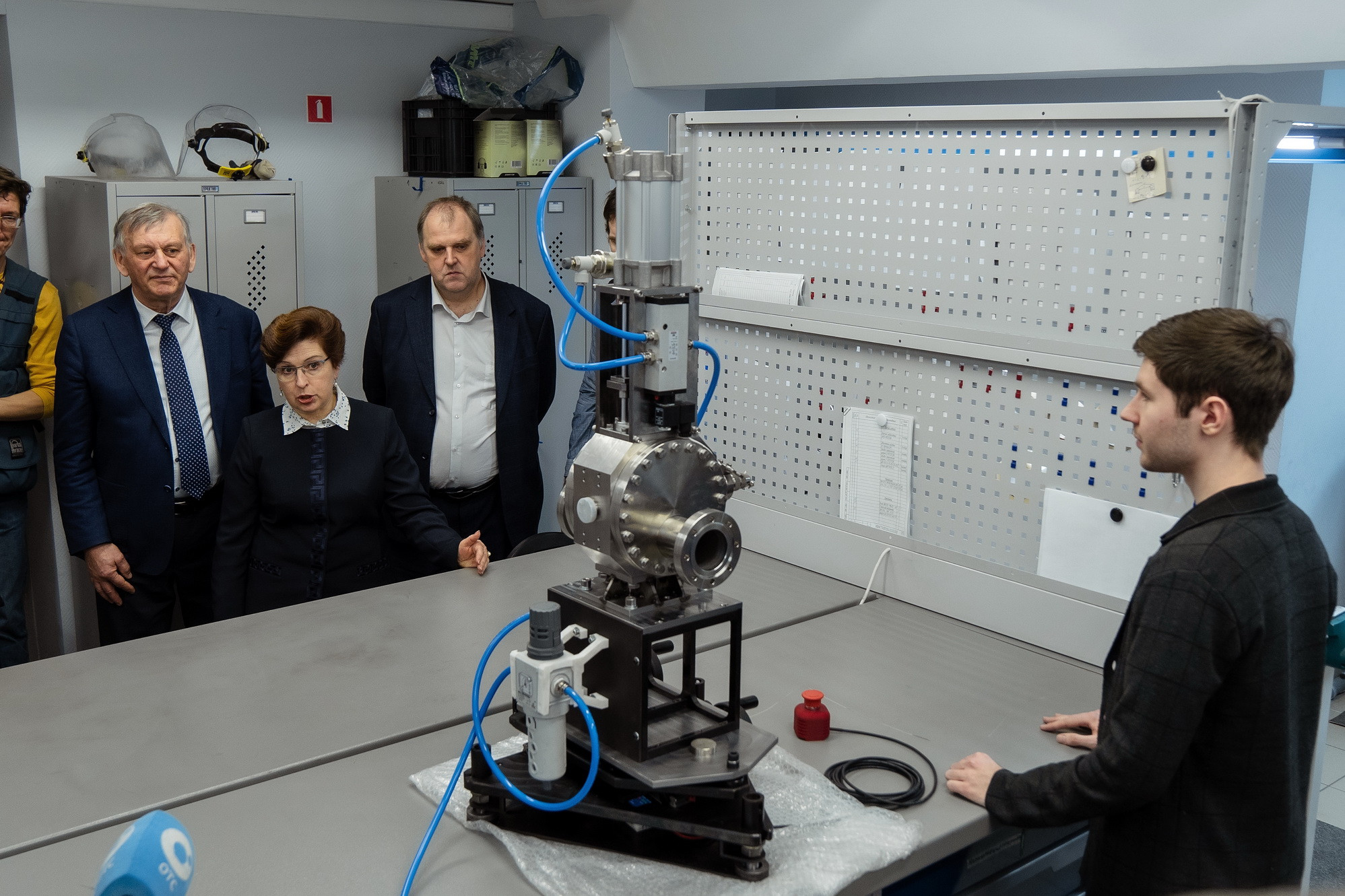
On December 24, during a press tour with the participation of Irina Manuilova, Deputy Governor of the Novosibirsk Region, NSTU-NETI demonstrated unique high-tech equipment for synchrotron sources for the first time.
"SKIF is being built on the territory of the Koltsovo science city under the supervision of the Government of the Novosibirsk region, Governor Andrey Travnikov oversees the project – every stage is under control. The launch of the linear accelerator has already taken place – this is the first stage of the synchrotron launch, and today we see the continuation of a lot of work, the assembly of equipment that will fill the stations of the first stage. These are 6 stations, each of which is a set of unique equipment, its manufacture requires the cooperation of many participants. NSTU has become one of the main participants – it is a technological university that not only trains engineering personnel, but also engages in developments for the high-tech industry, instrument engineering, and also undertakes the task of training personnel who will service SKIF equipment. A design bureau was set up to manufacture the equipment, which included university students. The government of the Novosibirsk Region supports these developments localized in our region," Irina Manuylova emphasized.
In the period 2022-2024, the university staff created eight units of unique equipment for the SKIF CCU. For example, for the Microfocus station, NSTU-NETI designed and manufactured a two-crystal monochromator designed to extract a given range of energies from a photon beam and is one of the main components of synchrotron radiation stations. The main elements of the monochromator are two silicon crystals, which require a thermal stabilization system, a vacuum system, precision mechanics devices, and a control system integrated with the station's control system. The anti-vibration protection of the equipment is provided by a granite slab weighing about two tons, made by special order of NSTU-NETI. The equipment also includes a slit block designed to form a synchrotron radiation beam with the required transverse dimensions, a monochromatic beam shutter for complete suppression of monochromatized radiation, a brake radiation collimator and an ionization chamber.
According to Jan Zubavicius, Deputy Director for Scientific Work at SKIF Central Research Institute, the equipment developed at NSTU-NETI is truly complex and unique, requiring competencies in a wide variety of fields. "NSTU-NETI has managed to create a combat-ready team with all the necessary professional skills and organize work at all levels. Thanks to the interaction of NSTU-NETI with both customers and contractors, it was possible to implement the plans on time and in strict accordance with the technical specifications. On the part of the SKIF CCU, we are grateful for the work done," said Jan Zubavicius.
To carry out work on SCIF, a design bureau was established at NSTU-NETI, which included specialists from various fields: mechanical engineering, physics, optics, microelectronics and information technology, including students of NSTU-NETI of various fields of study. The scientific and production sites of the project for the development and manufacture of high-tech equipment for SKIF were the Prototyping Center and the Center for Student Project Activities of NSTU-NETI.
"The implementation of work on the design and manufacture of high—tech equipment for the SKIF CCU within the framework of the Priority 2030 program is an ambitious and valuable task for NSTU-NETI in terms of competence formation. It is important for us to be among the first developers of sophisticated and, I emphasize, domestic scientific instruments. We have managed to effectively build a full cycle of work — from design to manufacturing. This was largely due to the involvement of scientific youth in the implementation of this project," said Anatoly Bataev, Rector of NSTU-NETI.